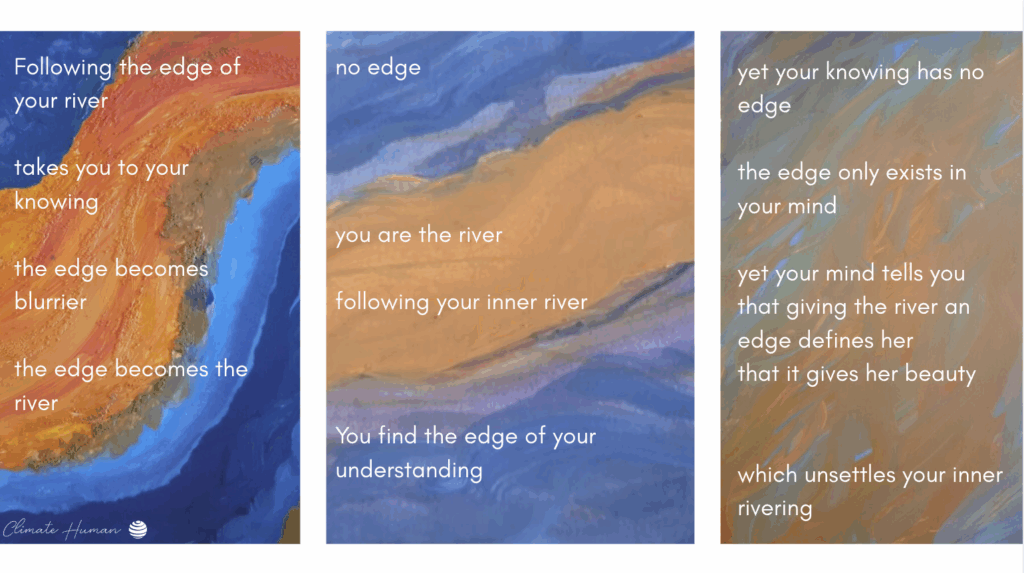
“Where is the edge of me?“: Nora Bateson’s provocative yet elusive words are often on my mind. They felt particularly alive lately when I was reflecting on what I/we know and how I/we know it in preparation for RM’s first learning summit. Why? What were these words waking up as I was attempting to unpack what and how I/we know?
To me, where is the edge of me speaks to the Zen Buddhist concept of inter-being.
At the end of 2024, I undertook the insightful Zen and the art of saving the planet course by Plum Village, rooted in Thich Nhat Hanh’s teachings. To help metabolise what the course had unfurled in me and also help remember what I was learning, I wrote a summary piece, in which one of the teachings focused on the notion of inter-being. In a nutshell, what I learnt then was that to be in service to life, we must take care of ourselves and examine our own suffering. Because, by taking care of ourselves, we are taking care of the earth, because we are earth. In deep ecology, we realise that we are more non-human than human and that we cannot exist by ourselves. The self is made of non-self elements, a community of symbiotic interconnection; with every cell in our being carrying the insight of inter-being. Where is the edge of me indeed…
To me, where is the edge of me speaks to the principles and practices of relationality and reciprocity, core to Indigenous Knowledges across the world.
Reading Robin Wall Kimmerer’s magical Braiding Sweetgrass rekindled a little fire in me which felt like a joy to get curious, imagine and share what knowledges in service to life could be. The book is an incredibly rich coming together of ideas, words and stories giving texture and grounding to concepts that often live separate lives: indigenous wisdom, scientific knowledge and the teaching of plants. Kimmerer shares many stories including about the making of maple syrup, the growing of sweetgrass, the planting of the ‘Three Sisters’, etc. Through these stories, she reminds us that the earth endows us with great gifts and that we have a responsibility to participate in the plants’ transformation and give our gratitude; perpetuating the cycle of reciprocity. Like for example in the growing and harvesting of food in ways that govern the exchange of life for life, according to indigenous principles of ‘Honourable Harvest’. In planting a garden in reciprocity, she says: ‘we fill our spirits as well as our bellies’. Where is the edge of the gardens we can plant in reciprocity…?
To me, where is the edge of me speaks of knowledge flows, understanding and story telling.
This reminds me of a story I haven’t shared yet. Back in high school, I used to love my philosophy class because we got to learn from many great thinkers about a mix of moral philosophy, human nature, neurosciences, etc. Fast forward twenty years, reading Jeremy Lent’s books have helped unpack some of the Dualism and Cartesian brainwash. I realise now that a lot of the teaching was western-centred and this participated in framing my worldview; which I have since learned to unlearn, nuance and enrich over the years.
I remember being surprised that these philosophy classes were mostly about learning about other people’s thinking rather than creating new thinking or tapping into your own philosophy. Instead, the philosophy we were taught was about learning to read and package other thinkers’ perspectives on a topic, to form arguments aligned with an overarching rationale [thesis, antithesis, synthesis].
I remember being really shocked when my philosophy teacher refused once to grade one of my essays, because he deemed it ‘not mine’. I had spent days thinking through the rationale and researching the various fragments that would together form the argument. I don’t feel proud to admit that my integrity got hurt and crocodile tears constituted my reaction to this wasted effort. Now that I think about it, I should have paused, laughed and responded: ‘Where is the edge of me?’
When I was 16, I already cared for nature, the planet and its beings – and I saw myself as a series of past experiences leading up to this point, a combination of nature and nurture. I already carried a strong sense of responsibility towards life. But that was a separate kind of responsibility – I did not see myself as life. I had to ‘save the planet’ but that did not encompass myself. I had not yet widened my views and learned with eastern traditions and indigenous wisdoms, to harmoniously consider the inter-being and relationality in knowing that ‘we are nature’.
Well, in this moment, I realise that the edge of knowledge has just dissolved before my eyes. Socio-economic context, past experiences, relationships, stories, books, podcasts, conversations, meditations, walks, time, naps, metabolisation, songs, poems, mistakes, feelings, intuition, gut microbiome, mind, body, river, trees, plants, birds, life… Where is the edge of what I know…? There is no edge but an alive process of learning…
Following the edge of your river