
Why create a culture of belonging?
At a time where polarisation and fragmentation are kings ruling much of societies’ interconnected systems at a planetary scale, focusing on the notion of belonging has felt potent and timely. Not only as a strategy to counter the local and global trends and tactics, but as a lifeline centring what matters and ways to embody the future we’d like to live in, right now. Having let go of many forms of illusion of control, my current understanding of how change can happen, this first note on belonging begins with self-reflection and stretching my own well-travelled neural pathways. In doing so, I am resisting the urge to reach out for definitions and inviting in an embodied exploration. One that authorises inner knowing – which is of course in relationship and guided by many intertwined influences (the concept itself of authorising your knowing first heard in a conversation between Lisa Miller and Martha Beck!). The intentionally outward-facing investigation will come next.
Belonging
To me, belonging means feeling home with my Self – safe and whole. It’s a somatic experience, not a purely cognitive one – which feels particularly relevant as I invite this embodied exploration, rather than conduct a literature review of its meaning. I belong where I can fully be my Self and feel alive. Our bodies know when they belong – or when they do not, when the context and conditions do not enable us to feel safe and whole.
I’ve come to understand belonging as a relationship, a dance between the inner and outer worlds. This form of knowing ignited in the first instance as a slowing down, a meandering through my own internal dialogues – those of a climate human battling through matters of worthiness in the context of climate emergency and collapsing ecosystems. It then transformed into a multi-sensory experience in relationship with place and in dialogue with life. And in unexpected ways, this evolution helped me touch more closely the profoundly traumatic effects of displacements caused by climate disasters and human negligence.
Learning with Internal Family Systems
When I say ‘feeling home with my Self’, I am referring to Richard Schwartz’s concept of the Self, a key tenet of the Internal Family Systems (IFS) psychotherapy which is grounded in the belief that every individual possesses a wise and kind centre – the Self – characterised by a total of 8 C qualities: Curiosity, Compassion, Calm, Clarity, Courage, Confidence, Creativity and Connectedness. I have come to the realisation that when I can feel these qualities in others and in me, I feel home, I belong. I can freely move with integrity from that centred-place and it radiates outwards, in turn affecting the quality of relationships with others. However, when for a variety of reasons, I cannot access my resources, or do not feel safe to be my Self, this also provides insight. Something is up. And when I see someone else unable to access theirs, I question what context and conditions might be collapsing in a moment and perpetuating – even if completely unintentionally – unhelpful cycles.
Disclaimer – Language bridge
I’ve recently come to understand that certain terms can carry baggage and a perception of ‘forcefulness’, perhaps when associated with a form of imposed ‘compliance’.
Did you perhaps get irritated reading the list of C words? Maybe you have been told to be ‘calm’ in the past in a way that felt like a suppression of your justified anger? I am sure that these situations or places or relationships did not feel like belonging to you.
Well, rest assured that this is not the kind of ‘calm’ I am referring to here. I am talking about a form of open-heartedness and empathy that comes from journeying through a range of emotions and suffering, and yet actively choosing peace. I am inviting curiosity towards what these emotions reveal and a form of dialogue that recognises patterns of injustice and yet doesn’t create more unnecessary mud. It definitely doesn’t feel like an end-state but a constant work in progress which I am learning and unlearning about, in part by listening to the words of wise humans, their cultures and practices.
Learning with Aboriginal Elders and Zen Buddhists
It feels important to honour at this point the wisdom of indigenous and eastern traditions, which centre relationality and inter-being in profoundly advanced ways. The ability to move through the world and conflicts, with an open heart, a quality of love and compassion, despite generations of colonisation and imposed suffering, is astounding. It’s not a kind of subdued quality – it’s a choice to move through the suffering, alchemise it and create opportunities for care that transcend individuality.
Some pretty rare and inspiring humans embody this quality of being – one which calms and helps co-regulate one’s nervous system – in the same way that being in the presence of a river or currawongs might.
Two people – whom I haven’t had the honour to meet in person but through their writing and whose quality of care radiates outwards – come to mind. One is Aboriginal Australian Uncle Banjo Clarke, who despite the great hardship he and his family faced, was renowned as a source of wisdom, kindness and calm in a chaotic world. The other is Vietnamese Zen Buddhist Master, spiritual leader and peace activist, Thich Nhat Hanh who, among many life accomplishments, founded the Plum Village monastery and authored the poem, ‘Call me by my true names’, inviting us to see ourselves in others, even in our strongest ‘enemies’:
‘Please call me by my true names,
so I can hear all my cries and my laughter at once,
so I can see that my joy and pain are one.
Please call me by my true names,
so I can wake up,
and so the door of my heart
can be left open,
the door of compassion.’
What I am unlearning
What does this have to do with belonging? Well, cultivating and watering the seeds of compassion – in part thanks to undertaking the Zen and the art of saving the planet course – has certainly helped me generate safety from within and finding home in the present moment.
The journey of growing compassion remained mostly outward facing though when it came to feelings. I could find compassion for what others would experience and why they would behave a certain way, but not really show the same kind of compassion for myself. Until very recently, I used to totally bypass my own emotions – carrying a Good Girl story around ‘this feeling isn’t constructive, move on and get on with the work’. ‘There is a climate emergency, you better get on with it.’ And although I have lived most of my adult life behaving like a mind on legs (thank you Descartes, Plato etc.), I am now in the process of re-membering. So, instead of bypassing what my body is experiencing – reverting to the hierarchical, vertical powers of my brain – I am getting curious about what the rest of my body is trying to communicate. And it turns out, quite a bit!
Alchemising the power of emotions
I am learning that a certain clarity can emerge from getting curious about my own emotions. It’s kind of both counter-intuitive and yet very obvious once you get it. I used to think that paying attention to something [whether thoughts or feelings] was a distraction which I didn’t want to fuel. I thought it’d follow the same logic as tech or social media platforms designed, through their algorithms and business models, to vampire our attention. The thing is – thoughts or feelings are not machines, they are human, and most people long to be seen and heard. So, what’s the worst thing I could do if I did not want to give oxygen to my thoughts or feelings? Ignore them. Of course, bypassed, they came back kicking and screaming and sending through unexpected curve balls. If I listened, however, magic happened. The same thing happened when in the process of writing my book, I slowed down and started listening to the cacophony of my inner thoughts. It completely transformed my inner world. And I decided to share these intimate thoughts with the outer world as a way to help normalise what’s never shared because perhaps considered ‘crazy’ (?). I have since completely flipped what I now consider useful – and this is partly why I am choosing to now share my feelings.
Now, let’s be upfront about the fact that, despite the value of better listening to our feelings, communicating from a state of dysregulated nervous system is likely not to land meaningfully in a strangers’ ears, let alone lead to any desired outcomes. Yet, meaning can be made through listening to and following the wisdom that is somewhat inconveniently wrapped up in raw emotions, which may well be the gift we can no longer ignore.
So here we are, but, why is it relevant to creating belonging?
From Good Girl-ing to Somatic Allyship
Well, what I also recently realised is that I had been moving through life blind-sided by another twisted Good Girl double-bind. The Independent and Competent Good Girl (thank you Kasia Urbaniak for outlining this one in your extraordinary book, ‘Unbound‘). It turns out I believed I had to independently and silently work stuff out by myself. So I wasn’t sharing until some neat insight had landed. Well well well, what a great way to perpetuate the disserving cycles of perfectionism.
Dang. Not only is it unhelpful but what a missed opportunity to connect and create belonging, by helping others feel seen and find themselves in the messiness!! This is why I’ve decided to up my vulnerability sharing game and open up about the discomfort of these emotions while I am metabolising instead of the oyster-style clamp down, the classic bypassing and getting on with doing whatever needs to be done. I recently heard in Staci Haines’ Politics of Trauma course a sentence that made me pause:
‘We didn’t hurt ourselves, why the hell do we think we can heal ourselves?’
That is a very good question. One that I have taken on board. Collective healing in progress, friends.
Fatigue
I recently learnt too that being exhausted can feel surprisingly revealing. It provides embodied evidence of what is not right for me.
[Let’s insert some space here to help this epiphany land.]
In the past, I would have ‘decided’ to push through and get on with it, and now I am choosing to listen to what my body is telling me. Flexibility, yes. Pretzel-contortioning, nope. Message received. And of course, there is a matter of balance here, of finding enough of what gives energy to compensate for what drains it away. To notice the shift in energy levels to gain greater awareness of what gives us life and cultivate those states, rather than falling into the well-travelled, let’s call them ‘action for worthiness’ highways.
The most insightful realisation in this state of fatigue was that I could not access my kind and open-minded Self [remember the 8Cs?]. That was critical information. I did not belong and needed to locate the conditions that would enable me to come back home. Generating safety through resting, time outside, reading, writing, dancing, listening to the humming, drumming and Oud music of my long-ignored ancestors. Where I feel whole and home.
Rage, Grief and Joy
I experienced a deep sense of rage and grief lately watching the very moving documentary, Floodlands, about the lived experience of communities impacted by the devastating 2022 Lismore floods. Floodland surfaces the intertwined trauma that is carried and how much of climate work is about healing. In peeling back the layers, it struck me how so much of the suffering was avoidable if settlers had listened before building a town on a floodplain. Listened to Country, to First Nations knowledge holders who had provided warnings and been ignored by arrogance. Listened to people whose lives have been impacted by extreme weather events. Listened to the strengths that exist locally. Listened to the aunties who – despite it all – find the grace to carry on weaving and healing.
Watching the documentary reminded me that much of my rage and grief fires up in my body when I feel a deep sense of injustice. When disasters hit, a bond with a place called home is severed, which is why avoidable and unfair displacement feels particularly shattering.
The irony isn’t lost on me that, in spite of my plea for the importance of ‘Listening’, until very recently I had not been listening to my own body either – yes, indeed, colonisation runs deep. Which is perhaps where the deepest and most meaningful collective liberation lives. Nurturing our capacity to move through our collective grief, unlearn, let go of what no longer serves us and come through the ‘other side’ with a delicate appreciation of the miracle of life in its simplest moments. Being able to hold grief and joy so tightly together that they no longer seem unhelpfully paradoxical. Instead they tango to the rhythm of our heart beats and help us move through life in integral and meaningful ways.
As the exquisite quote from Kahlil Gibran remind us:
‘The deeper that sorrow carves into your being, the more joy you can contain.‘
This transformation of how movements face loss and catalyse collective grief into powerful leadership and action is at the centre of the Black-led Radical Loss Project, founded by Malkia Devich-Cyril, and something the climate movement would certainly benefit from learning with.
A house of belonging
Well, this note was much bigger and took longer than I had anticipated. It probably started germinating after reading David Whyte’s beautiful House of Belonging poetry and took on a life of its own.
‘This is the temple
of my adult aloneness
and I belong
to that aloneness
as I belong to my life.
There is no house
like the house of belonging.’
I’ve come to understand that the loneliest I ever experienced was when I became estranged from myself. Estranged from my Self. Now that I re-member my connectedness, I cannot ever feel alone in that way again. Or when a part of me does, I know it’s time to come home, where I belong.
It’s funny that the mundane process of completing the 2026 Australian census prompted me to ask myself the somewhat banal ‘What do you do?’ question. Away from all the noise, a simple answer emerged:
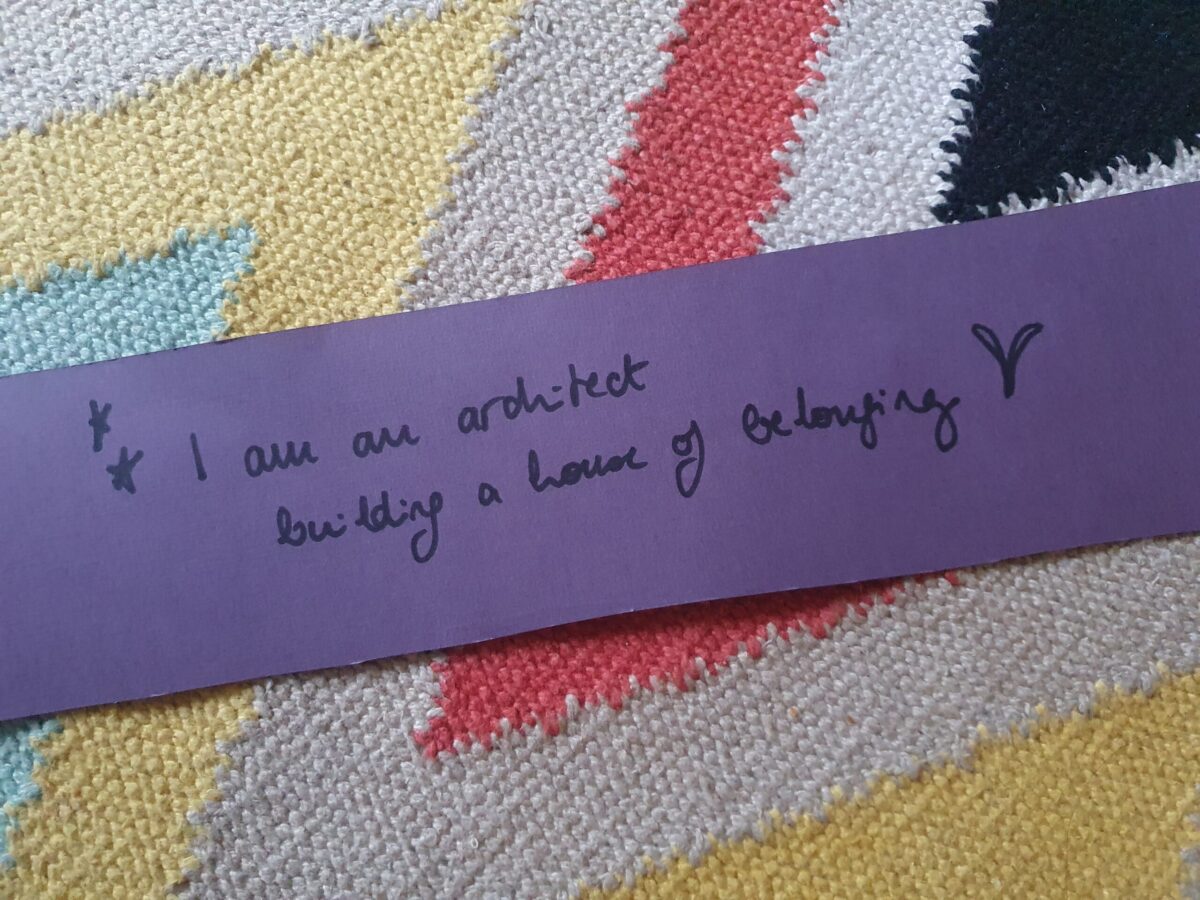
‘I am an architect building a house of belonging.‘
Where we can shed old armours and invite back what makes us feel more alive and belong with one another. Where we get to grow our collective capacity to recognise, listen to and play the songs that make our hearts sing. With grief and joy.
Belonging, by Joy Bark
A slowing down that helps you remember
A beautiful sight in which to linger
Expending your appreciation of what is now
Which exists in the silence between the notes
Nothing
Nothing else is needed
When all is already here
Shimmering before your eyes
You can let go and let the moment set you free
Let the song guide you home
Inside your heart
Belonging cannot be bought